Blog
Turning Wearable Data Into Actionable Insights
Accessing wearable data is only the first step. The real value emerges when raw metrics become structured, comparable, and decision-ready insights — the shift we described when ROOK was founded on the idea of empowering…
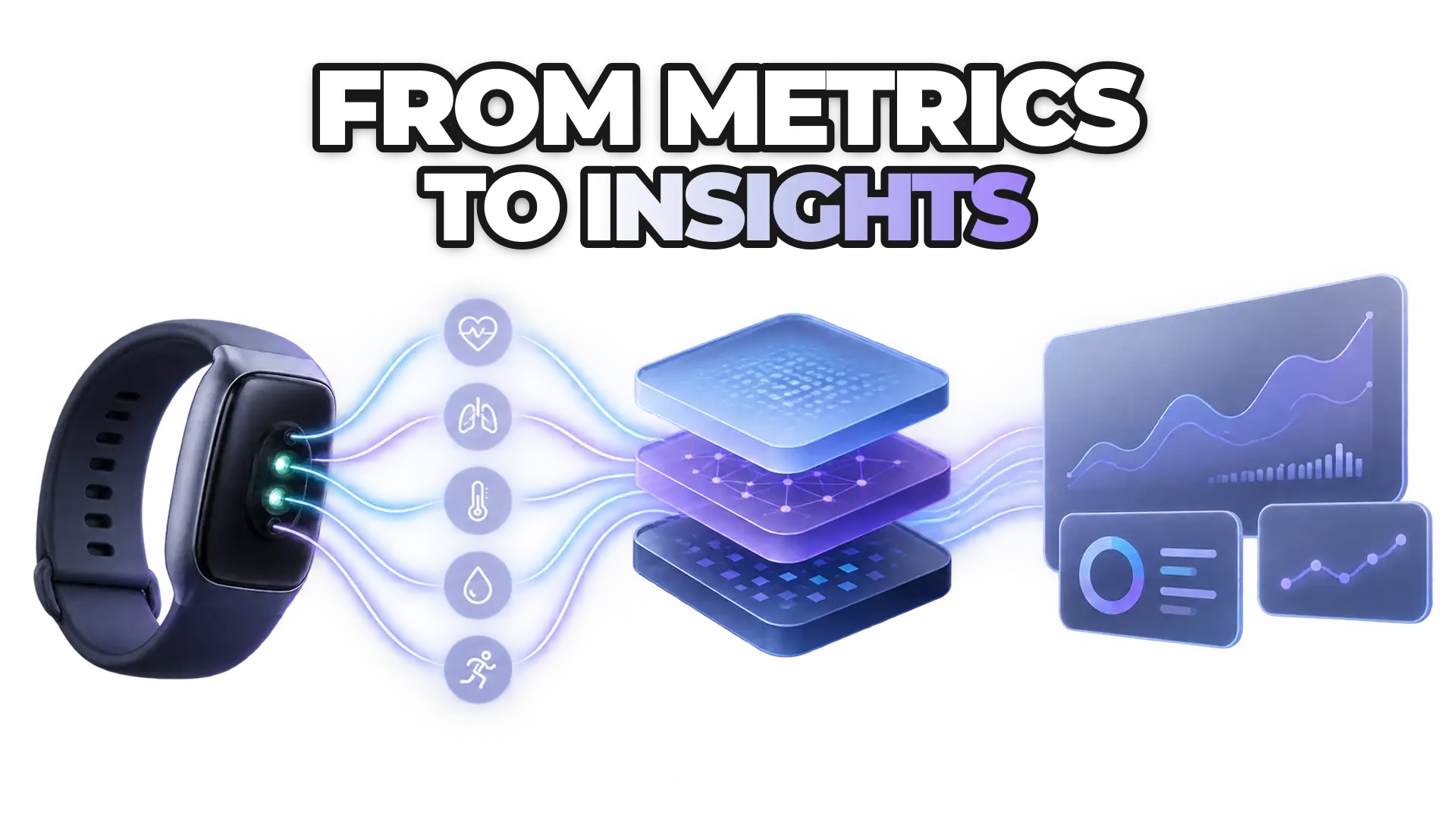
Accessing wearable data is only the first step. The real value emerges when raw metrics become structured, comparable, and decision-ready insights. Raw data is useless without standardization; standardization requires normalizing device-specific metrics into a common schema, tracking changes over time, and deriving product-level indicators that inform decisions. This article walks through the five steps from raw signals to actionable insights, and shows why the best products prioritize structure over volume.
In 2026, organizations that succeed with wearable data do not focus on volume. They focus on clarity, consistency, and usability. The research has moved in the same direction: a January 2026 paper in Nature Communications on transforming wearable data into personal health insights using large language model agents showed that the hard part is not retrieving the numbers but reasoning over them correctly — the agent reached 84% accuracy on objective numerical questions only because the underlying measurements were structured well enough to compute on.
In this article, we explain how to move from raw wearable metrics to actionable insights that support product decisions, personalization, and scalable analytics.
Raw data is not the final product
Wearable devices generate continuous streams of biometric signals. These may include:
Heart rate readings at short intervals
Movement data from accelerometers
Sleep stage classifications
Oxygen saturation measurements
While detailed, raw data presents challenges:
High volume
Inconsistent sampling rates
Device-specific schemas
Complex preprocessing requirements
Most product teams do not need raw signals. They need structured indicators aligned with business logic. The FAIR guidelines for data management — findable, accessible, interoperable, reusable — capture this: data that is merely available is not the same as data that is usable. A wearable metric is usable only when every field is named consistently, the units are documented, the measurement window is clear, and the aggregation rules are enforced across devices.
Step one: standardize metrics across devices
The first requirement for generating insights is comparability.
Different manufacturers calculate metrics using:
Proprietary algorithms
Distinct thresholds
Varying time windows
Different aggregation methods
Every source added to your product brings its own conventions. ROOK normalizes data from 72 health data sources across wearables (Apple Watch, Garmin, Fitbit, Oura, Withings, WHOOP, Polar), medical devices (Dexcom), Health Connect, and EHR/EMR systems. Each vendor defines heart rate, sleep stages, activity, and recovery differently — different sampling intervals, different filtering, different aggregation windows. Bringing them into one schema is the first step toward insight.
Without standardization, combining data from multiple devices may distort:
User scoring systems
Engagement metrics
Risk models
Performance indicators
Practical approach
Define clear metric definitions at the platform level.
Map manufacturer-specific fields into a unified schema.
Normalize units and time zones.
Apply consistent aggregation rules.
Units deserve a real standard rather than a convention in a spreadsheet: UCUM, the Unified Code for Units of Measure, maintained by the Regenstrief Institute, is the code system healthcare data exchange uses for exactly this, and adopting it early prevents the "minutes or seconds?" class of bug from reaching your analytics.
Standardization ensures that a metric has the same meaning across your entire user base.
Step two: contextualize metrics over time
Single data points rarely generate insight. Trends and deviations provide more value.
For example:
A resting heart rate reading is informative.
A sustained increase over seven days is actionable.
Longitudinal analysis enables:
Baseline creation per user
Trend detection
Behavioral change tracking
Anomaly identification
Wearable data is inherently time-series data. A single blood pressure reading is ambient noise. A seven-day rising trend is a signal. A two-week sustained elevation with increasing variability is actionable. Designing your storage for longitudinal queries — "show me the trend in this metric over the last 90 days, aggregated by week" — is not optional. Without the time-series structure, you cannot compute baselines, detect deviations, or model change.
Step three: transform metrics into product-level indicators
Raw metrics become actionable when aligned with product logic.
Examples:
Transform daily activity into engagement scores.
Convert sleep consistency into recovery indicators.
Translate heart rate variability into readiness levels.
These derived indicators should:
Follow clear definitions
Remain consistent across devices
Be explainable to internal teams
Align with product objectives
ROOK Score 2.0 illustrates this: it combines normalized inputs (activity, sleep stage quality, resting heart rate, heart rate variability, respiratory rate where available) under three pillars (physical, sleep, body health). Because the input metrics are standardized across devices, the same ROOK Score has the same meaning whether the user wears an Apple Watch or a Garmin. The product team defines once; the metric works for all devices.
Derived indicators reduce cognitive load for end users and simplify product design.
Step four: segment and personalize
Once metrics are standardized and structured, personalization becomes scalable.
Wearable insights can support:
Behavior-based user segmentation
Adaptive notifications
Dynamic goal setting
Individualized recommendations
This is the operating principle behind AI and wearables: personalized health at your fingertips. Specific populations show why segmentation needs real structure underneath it: cycle-aware features depend on consistent longitudinal signals, as we explain in using wearables for menstrual health tracking, how wearables are transforming menstrual cycle tracking, and women's health: wearables as a gateway.
Personalization requires:
Reliable data ingestion
Stable metric definitions
Historical continuity
Without consistency, personalization logic becomes unstable.
Step five: support predictive modeling
Wearable data provides high-frequency, longitudinal signals. When structured properly, it can enhance predictive models.
Examples include:
Risk trend detection
Engagement forecasting
Churn prediction
Performance optimization
The scale this is now reaching makes structure more important, not less. In July 2026, Google Research presented SensorFM, a foundation model for wearable health data pre-trained on more than a trillion minutes of sensor data from five million people, and one of its central design problems was handling the fragmented, incomplete sensor records that wearables actually produce. Whatever the model, the inputs decide the ceiling.
Predictive modeling depends on:
Clean data pipelines
Consistent feature definitions
Controlled handling of missing values
Cross-device normalization
Model performance deteriorates when input definitions change over time. If your models will ever be published, audited, or defended to a partner, the TRIPOD+AI reporting guideline sets out what has to be documented about the data and the features — a useful checklist even when no publication is planned. This is also why programs built on measurable outcomes insist on standardization first, as we argue in why the ACCESS model needs standardized wearable data and why wearable data alone may not be enough.
Reducing data science overhead
Many organizations underestimate the operational cost of transforming wearable data.
Common hidden costs include:
Ongoing schema maintenance
Handling API changes
Managing missing data
Reprocessing historical datasets
Updating feature engineering pipelines
We quantified this pattern in the hidden cost of point-to-point integrations, and the market itself has been consolidating around it — see what the Validic and Spike acquisitions mean for health data API buyers.
Delivering structured, normalized data upstream reduces the burden on internal data teams. The ROOKConnect documentation describes that upstream layer: authorization, extraction, processing, and delivery handled once, with a single data model coming out the other end. The effect is visible in how quickly teams can build on top of it, including on low-code platforms — see our Base44 integration and Lovable integration.
When product teams receive analytics-ready metrics, they can focus on:
Experimentation
Feature iteration
User experience design
Instead of maintaining ingestion infrastructure.
Visualization and user communication
Insights must be interpretable.
Effective wearable insights should:
Use consistent terminology
Present trends clearly
Avoid device-specific bias
Remain transparent in calculation logic
Clarity builds trust. When users understand how metrics are derived, engagement improves — the argument we made in the health revolution is in your pocket. Before designing the visual layer, it helps to look at real data from real devices: the ROOK Extraction App lets a team collect from mobile and API-based sources and see the actual shape of the output before committing to a chart or a score.
Avoiding common pitfalls
Turning wearable data into insights requires avoiding common mistakes and respecting scope boundaries. ROOK moves health data and normalizes signals; it does not provide prediction, recommendations, anomaly detection, or automatic alerts—those are your product's job once you have structured inputs.
Over-relying on proprietary composite scores
Ignoring cross-device inconsistencies
Treating all metrics as equally reliable
Failing to track data gaps
Mixing raw and aggregated values without clear distinction
A structured data model reduces these risks. A pre-launch verification pass reduces them further — we published one for outcome-based programs in the pre-launch verification checklist, and the underlying build-versus-buy trade-off is examined in in-house versus third-party solutions.
The role of a unified wearable data architecture
A unified architecture supports insight generation by:
Providing a single integration layer
Normalizing metric definitions
Managing OAuth flows centrally
Delivering structured, device-agnostic data
A unified architecture means a product team can design an insight once — a health score, a readiness metric, a recovery assessment — and apply it consistently across their entire user base, regardless of which wearables users own. This consistency is non-negotiable for outcome-driven programs (outcome-based contracting, value-based care models, corporate wellness programs), where different users in the same program must measure the same outcome the same way.
How we approach insight generation at ROOK
At ROOK, we focus on transforming fragmented wearable data into structured, usable information — the problem we set out to solve from the start, as described in our pre-seed funding and rebrand announcement.
Our approach includes:
Aggregating data from multiple manufacturers
Standardizing metric structures
Maintaining consistent definitions
Delivering analytics-ready outputs
By abstracting integration complexity, we enable teams to focus on insight design rather than data normalization. You can see the range of outcomes teams have built in use cases and industries, and how the same foundation supports partnerships and regional programs — from our alliance with Alula Technologies to our work with ASDeporte on sporting events in Mexico and our selection for the Tampa Bay Wave accelerator.
We also discuss how insights get built in our own conversations: the podcast and media collection includes episodes on turning wearable data into real health insights and turning wearable noise into boardroom gold, earlier conversations cover what to do with all that data and the medical data behind everyday wearables, and our alliance episodes show how far wearable health data can take us in practice.
Final thoughts
Wearable data becomes valuable when it informs decisions.
Moving from raw signals to actionable insights requires:
Standardization
Longitudinal analysis
Clear metric definitions
Scalable architecture
Organizations that prioritize structure over volume are better positioned to build reliable, data-driven products. The clearest illustration is what happens at programme scale, where hundreds of organizations have to report comparable outcomes — see breaking down the companies accepted into the ACCESS model.
The goal is not to collect wearable data. The goal is to convert it into standardized, longitudinal, device-independent insights that scale. When a team has structured data, they can personalize without inconsistency, detect trends without noise, test products without rebuilding the data layer for each new device, and defend their outcomes because the input is documented and reproducible.
 Written byJuana Carolina Ordoñez MerchanInternal Digital Marketing