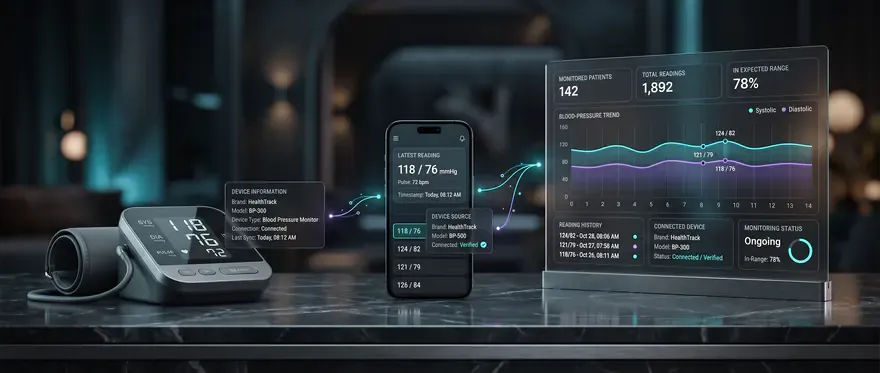
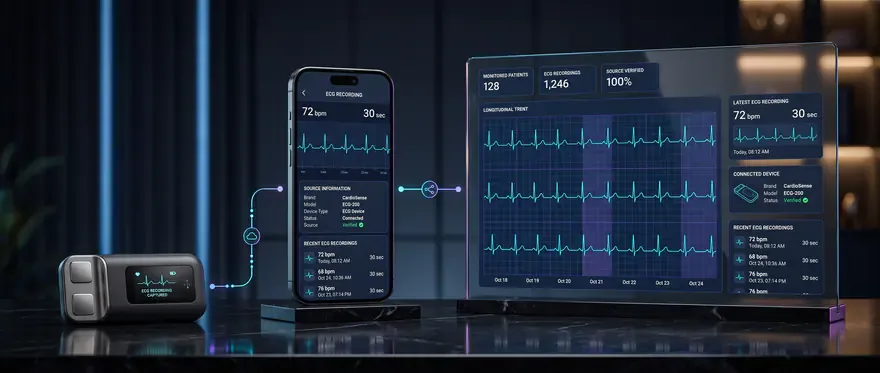
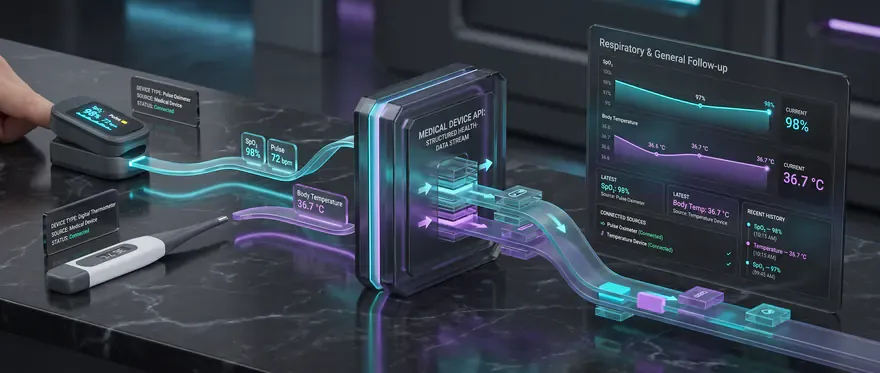
{ "data_structure": "blood_pressure_event", "device_source_data_array": [ { "device_type_string": "Activity Tracker", "manufacturer_string": "Withings", "model_string": "ScanWatch 2", "source_type_string": "wearable/sdk" } ]}Medical device readings, with the device that recorded them
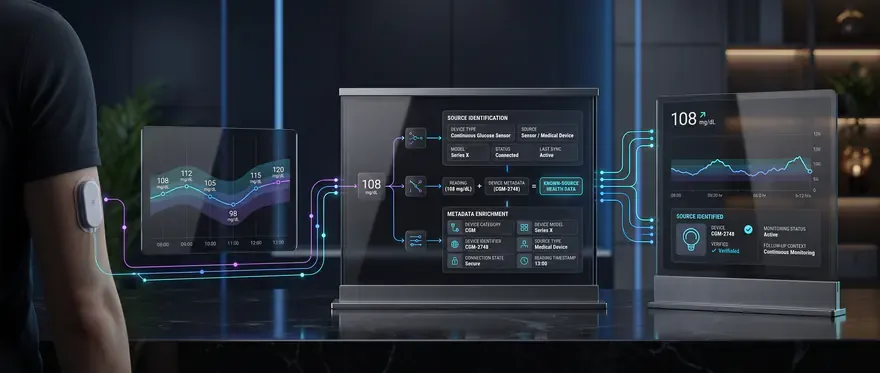
The ROOK Connect Medical Device API delivers glucose, blood pressure, oxygen saturation, temperature and ECG readings in one format, with the device that recorded each one.
How it works
From the device to your backend in three steps
A blood pressure reading of 140/90 doesn't mean the same thing if it came from an upper-arm cuff or a wrist watch. With the Medical Device API, every reading arrives with its source, so teams know exactly what data they are working with.
Users take a reading
Users take their readings with supported devices connected through ROOK Connect.
ROOK identifies the device
ROOK adds information about the capturing device to every reading.
Your backend receives both
Readings reach the backend via webhook, with the value and its source in a single record.
What's measured and where it comes from
Five readings, each tagged with its device
Glucose, blood pressure, oxygen saturation, temperature, and ECG arrive from supported sources with the manufacturer, model, device type, and source type attached.
Measurements
Glucose · Blood pressure · Oxygen saturation · Temperature · ECG
Supported sources
Apple Health · Withings · Dexcom · Health Connect · Samsung Health
Device details
Every supported event includes the manufacturer, model, device type, and source type the data came from.
Benefits
Readings you can compare, whatever device took them
Device details travel inside each event, in one structure for every device, on the ROOK Connect integration you already run.
Source in every reading
The value and the device that took it travel together, with no need to cross-reference other data.
One format for different devices
Blood pressure monitors, glucose sensors, and watches arrive in the same structure.
Context for every program
Teams decide how to use each reading based on the type of device that recorded it.
On top of the current integration
Device details are added to the events ROOK Connect already delivers, with the same endpoints and the same webhook.
Use cases
Care programs built on readings with a known source
Diabetes, hypertension, cardiovascular, and respiratory programs use the device behind each reading to give context to their follow-up workflows.
01Diabetes programs
Continuous glucose readings with the sensor identified, ready for metabolic follow-up programs.
02Hypertension follow-up
Readings from connected blood pressure monitors, with brand and model, for remote monitoring programs.
03Cardiovascular programs
ECG recordings from supported devices, with their source documented.
04Respiratory and general follow-up
SpO₂ and body temperature readings integrated into the same health data stream.
Medical Device API
Every reading, with certainty about where it came from.
The Medical Device API adds the source of every measurement to ROOK Connect data, so each program works with complete information.
Read more in our technical documentationFAQ
Frequently asked questions about the Medical Device API
Which devices connect, how users authorize them, and what ROOK is and is not.
What is the ROOK Connect Medical Device API?
The Medical Device API is ROOK’s capability for integrating measurements from compatible devices and sources, including glucose, blood pressure, oxygen saturation, temperature, or ECG when those data are available. Coverage depends on the device, intermediary platform, and user permissions.
Which medical devices and sources can I connect?
Current coverage includes compatible measurements received from sources such as Apple Health, Health Connect, Samsung Health, Withings, and Dexcom. The ROOK team can confirm the required device, model, metric, and integration path for each case.
Browse the source directoryHow is a medical device different from a wearable in ROOK?
The primary difference is the origin and type of measurement. A wearable commonly generates ongoing activity, sleep, or wellness data, while a medical device may generate specific measurements and device metadata. A source appearing in ROOK does not mean every device or measurement from that source has a medical classification.
Can ROOK identify the device that generated a measurement?
When the Device Metadata add-on is enabled and the source is compatible, ROOK can include the manufacturer, model, device type, and other available metadata.
Is ROOK a medical device or FDA approved?
No. ROOK is software infrastructure for connecting, processing, and delivering data; it is not presented as an FDA-authorized medical device. The regulatory classification of the final solution and the use of the data are the customer’s responsibility.
How does the user authorize access to device data?
The flow depends on the source. A user may authorize an account through the provider’s process or grant permissions in Apple Health or Health Connect. ROOK only receives measurements that the source makes available and the user authorizes.
No questions match that yet. Try another word or topic.
ROOK structures and delivers available readings from supported devices. It is not a medical device, and clinical interpretation and care decisions remain with qualified healthcare professionals.