Blog
Best Practices for Wearable Data Privacy and Compliance
Wearable data often includes health-related and behavioral information. Organizations that integrate this data into their platforms must design privacy and compliance strategies from the beginning.
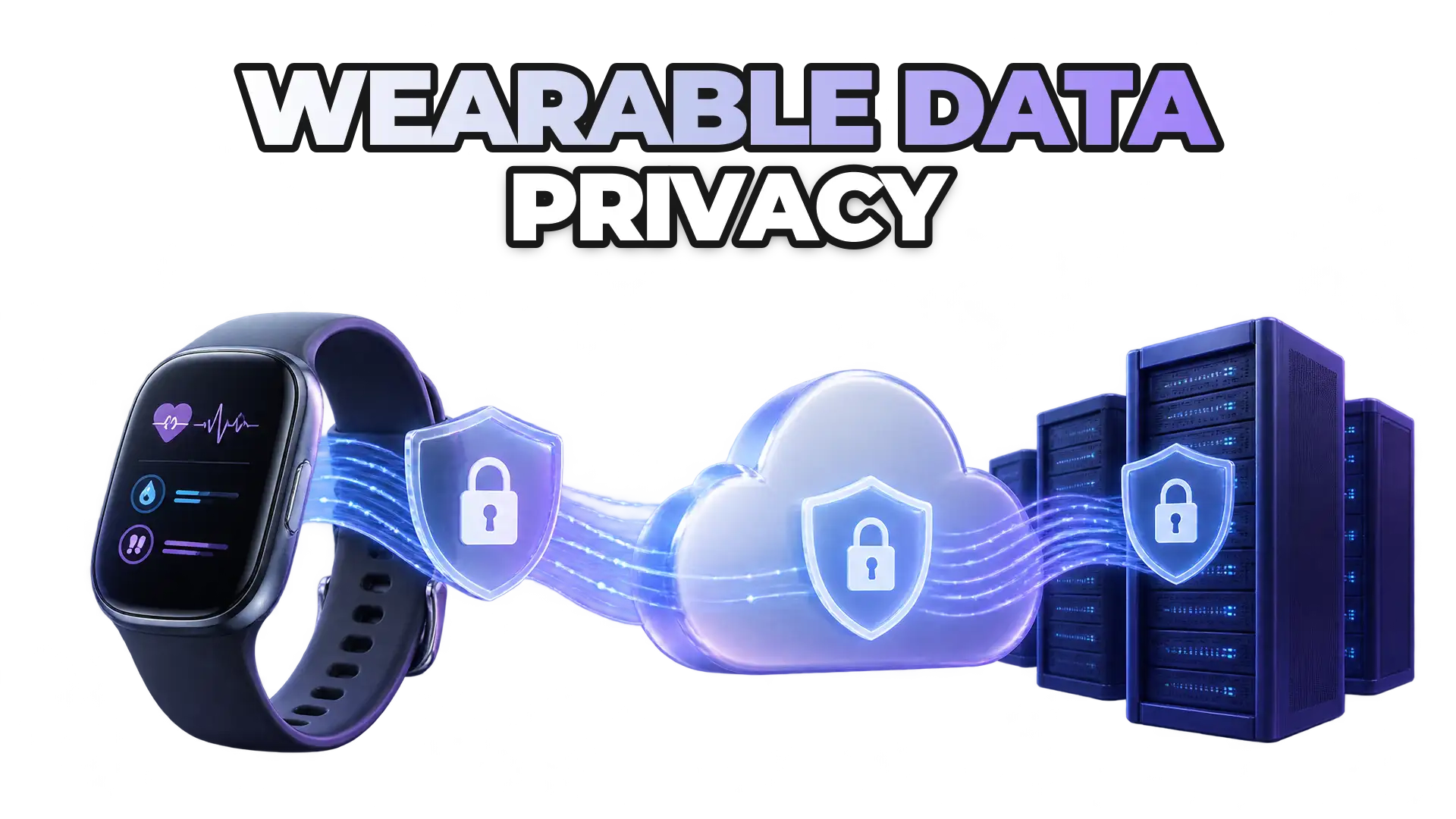
Wearable data reveals sensitive health and behavioral patterns — sleep, activity, heart rate, oxygen levels, and trends over time. Organizations integrating this data into their platforms must design privacy and compliance strategies from the beginning: explicit consent, data minimization, secure encryption, token management, regulatory alignment, user rights, retention policies, audit trails, privacy-by-design architecture, and third-party oversight.
Privacy is not only a legal requirement. It is a structural component of sustainable wearable data architecture.
In this article, we outline best practices for managing wearable data responsibly, reducing regulatory risk, and building user trust.
Understanding the sensitivity of wearable data
Wearable devices can collect:
Heart rate and HRV
Sleep patterns
Activity levels
Oxygen saturation
Behavioral trends over time
Even when not classified as medical data, this information can reveal sensitive patterns about an individual's health and lifestyle.
The regulatory line between wellness and medical is narrower than most teams assume. The FDA's guidance on General Wellness: Policy for Low Risk Devices, issued in January 2026, excludes from device regulation only products intended for maintaining or encouraging a healthy lifestyle and unrelated to the diagnosis, cure, mitigation, prevention, or treatment of a disease. The moment your product claims something clinical about the same heart rate data, the classification — and the obligations — change. Because that boundary depends on intended use rather than on the sensor, your use case determines your compliance surface; the range of contexts is visible across use cases and industries.
Organizations should treat wearable data as sensitive by default and apply appropriate safeguards.
1. Implement explicit and informed user consent
Before accessing wearable data, users must clearly understand:
What data will be accessed
How it will be used
How long it will be stored
Whether it will be shared with third parties
Best practices
Use clear, non-technical language in consent screens.
Align requested OAuth scopes with actual data needs.
Avoid requesting unnecessary permissions.
Provide users with the ability to revoke access easily.
Consent must be specific, informed, and revocable. Operationally, the quality of consent depends on how authorization is designed: a consent flow should show the user exactly what data will be accessed (heart rate, sleep, activity), how long it will be stored, and whether it will be shared, tied to a specific action rather than buried in onboarding. The ROOK Extraction App implements this pattern by binding a user through a QR code or universal link and walking them through source authorization one provider at a time, so each permission request stays visible and revocable.
2. Apply data minimization principles
Data minimization reduces risk exposure.
Instead of collecting all available wearable metrics, organizations should:
Define which metrics are required for product functionality.
Avoid storing redundant raw signals when structured metrics are sufficient.
Limit historical retention to what is operationally necessary.
Collecting less data simplifies compliance and lowers security risk.
3. Secure data in transit and at rest
Wearable data moves across multiple systems:
From device to manufacturer cloud
From the manufacturer API to your backend
From backend to analytics systems
Each step requires protection.
Best practices
Use encrypted connections (HTTPS/TLS).
Encrypt sensitive data at rest.
Restrict internal access through role-based permissions.
Log and monitor access events.
"Use TLS" is not a complete specification. TLS 1.3 (RFC 8446) removed the legacy cipher suites and handshake modes that older configurations still permit, so pinning your minimum version is part of the control, not a detail. For US healthcare contexts, the HIPAA Security Rule sets out the administrative, physical, and technical safeguards expected for electronic protected health information — a useful baseline even for organizations that are not covered entities.
Security architecture should assume that health-related data requires strong protection standards.
4. Manage OAuth tokens securely
OAuth tokens grant access to user data. If compromised, they may allow unauthorized data retrieval.
Best practices
Store tokens securely using encrypted storage.
Avoid exposing tokens in logs.
Implement automatic token refresh flows.
Remove tokens immediately after user revocation.
Revocation deserves a real implementation rather than a database flag: OAuth 2.0 Token Revocation (RFC 7009) defines the endpoint that tells the provider to invalidate a token, so a user who disconnects in your app is actually disconnected upstream and not merely hidden from your UI.
Token lifecycle management is part of privacy protection.
5. Align with regulatory frameworks
Depending on geography and use case, organizations may need to align with frameworks such as:
GDPR (European Union)
HIPAA (United States, if applicable)
Regional data protection laws
Regulatory classification depends on:
Type of data processed
Purpose of processing
Relationship to healthcare services
Organizations should consult legal experts to determine applicable obligations. ROOK does not provide legal advice, and nothing here substitutes for it.
Key regulatory principles often include
Lawful basis for processing
Data subject rights (access, deletion, portability)
Breach notification requirements
Accountability and documentation
Research and secondary use carry their own rules, and they are moving: in 2026 the European Data Protection Board opened consultation on Guidelines 1/2026 on the processing of personal data for scientific research purposes, which matter to any platform whose wearable data may later feed studies or real-world evidence.
Compliance must be built into operational workflows, not treated as a separate layer.
6. Enable user rights and transparency
Users increasingly expect transparency around their data.
Organizations should provide:
Clear privacy policies
Access to personal data summaries
Data export mechanisms where applicable
Simple deletion workflows
Transparency builds trust and supports regulatory alignment.
7. Define data retention policies
Wearable data is longitudinal and accumulates over time. Without retention limits, storage risk increases.
Define:
Maximum retention periods
Conditions for deletion
Archiving rules
Handling of inactive accounts
Retention policies should align with business requirements and regulatory obligations.
8. Audit and monitor data flows
As wearable integrations scale, visibility becomes critical.
Organizations should:
Document data flows from ingestion to storage.
Maintain records of processing activities.
Monitor API usage and data access patterns.
Conduct periodic internal reviews.
The NIST Privacy Framework gives this work a structure — a voluntary risk-management model for identifying and managing privacy risk that maps cleanly onto the identify, govern, control, and communicate activities described above.
Auditing reduces blind spots and strengthens accountability.
9. Design privacy into architecture
Privacy should be embedded in system design.
Privacy-by-design principles include:
Limiting data collection by default
Separating identifiers from health metrics
Applying anonymization or pseudonymization where possible
Using aggregated reporting when individual data is not required
This is not an abstract preference: the EDPB's Guidelines 4/2019 on Article 25, data protection by design and by default set out what regulators expect to see built into a system from inception rather than added later.
Aggregation is often the cheapest privacy win available. When a product needs to know whether a user is improving rather than what their raw signals were, a derived score can replace the underlying record set entirely — which is how ROOK Score 2.0 works, returning physical, sleep, and body health pillars computed from normalized inputs instead of exposing every measurement downstream.
Architectural decisions made early determine long-term risk exposure.
10. Manage third-party dependencies
When integrating wearable data, organizations often rely on:
Manufacturer APIs
Cloud providers
Analytics platforms
Unified API providers
Each third party introduces compliance considerations. The count matters: connecting directly to a long list of providers means a separate review, agreement, and monitoring obligation for each one, and there are more than 400 wearables and health data sources in the ecosystem, split between API-based platforms and SDK-based mobile sources with different provisioning rules — some, such as Dexcom and WHOOP, require the client organization to hold its own developer account.
Best practices include:
Reviewing vendor security documentation.
Signing appropriate data processing agreements.
Evaluating cross-border data transfer implications.
Monitoring vendor policy updates.
Compliance responsibilities extend beyond internal systems.
Common privacy risks in wearable integrations
Organizations should proactively address:
Over-collection of data
Inconsistent consent management
Unsecured token storage
Mixing identifiable data with aggregated analytics
Lack of deletion mechanisms
Many privacy risks originate from architectural shortcuts during early development stages.
How we approach privacy and compliance at ROOK
At ROOK, we treat wearable data as sensitive by default.
Our approach includes:
Centralized OAuth management
Structured and normalized data delivery
Secure API architecture
Clear separation between authentication and data layers
Documentation that supports responsible implementation
That separation is documented end to end in the ROOKConnect documentation, which describes authorization, extraction, processing, and delivery as distinct stages across sandbox and production environments — so the team implementing a consent flow and the team handling stored metrics are working against clearly bounded surfaces.
By abstracting integration complexity, we help organizations maintain structured and compliant data pipelines.
We also discuss this openly rather than only in documentation: our podcast and media hub opens with episodes on secure health data integrations and whether you can trust your wearable, earlier conversations cover the medical data behind everyday wearables and what a universal language for health tech would require, and our partner and alliance episodes feature insurers and digital health companies describing how they handle these obligations in production.
Final thoughts
Wearable data privacy is not optional. It is foundational to sustainable product development.
Organizations integrating wearable data should prioritize:
Clear consent flows
Data minimization
Strong encryption
Regulatory alignment
Transparent user communication
A privacy-first architecture protects users, reduces legal risk, and strengthens long-term trust.
As wearable adoption grows in 2026 and beyond, responsible data governance will remain a core requirement for any organization working with wearable data.
 Written byJuana Carolina Ordoñez MerchanInternal Digital Marketing