Blog
Health Kits vs. ROOK: Do You Need More Than Apple Health?
Apple Health and Google Fit are tied to one platform and store basic data. ROOK integrates with both, plus wearables directly, in one format.
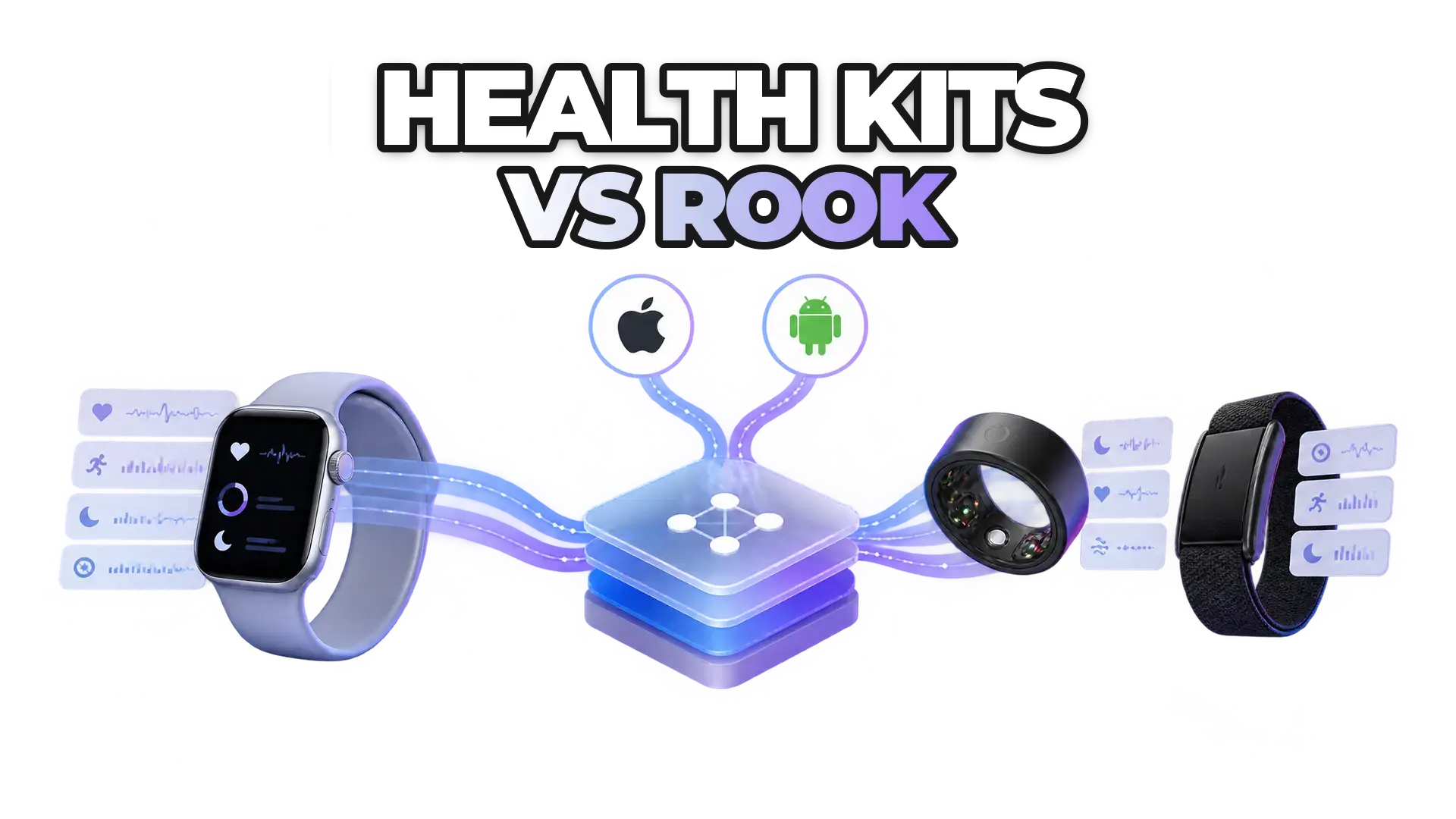
Apple Health and Google's Health Connect are useful data sources, but each is tied to one mobile platform and stores mostly basic data points, without vendor-specific metrics such as Oura sleep scores or WHOOP strain. ROOK integrates with both and with wearables directly, then standardizes the data into one format regardless of source, platform, or hardware. The answer is Health Kits via ROOK, not Health Kits vs. ROOK.
What data do Health Kits like Apple Health and Google Fit leave out?
Apple Health and Google Fit primarily offer basic health data points. Google Fit, for example, provides only six usable health measurements. Neither platform stores vendor-specific data like sleep scores from Oura or strain data from WHOOP, both lack real-time data, and both rely on summaries and averages, leaving users with fragmented, device-dependent information.
Why does mobile platform dependency limit Health Kits?
Health Kits are tied to their mobile platforms: Apple Health to iOS and Google Fit to Android. Apple Health may not have information about Android users, and vice versa, which makes it hard for businesses to reach a diverse user base through either one alone.
Will Apple and Google agree on one health data format?
Apple and Google are unlikely to agree on a common interpretation of health and wellness data, because they compete and keep expanding their own offerings. That competition increases the demand for a neutral standardization layer like ROOK.
How does ROOK standardize health data across sources?
ROOK standardizes, harmonizes, and normalizes wearable and biomarker data so it is usable regardless of the data source, mobile platform (iOS or Android), or hardware. ROOK supports 72 data sources and more than 500 devices.
ROOK's data processing streamlines integration, eliminates duplicates, and standardizes data from diverse sources. For how duplicates are handled, see how ROOK eliminates duplicate wearable data.
ROOK also provides a health score that works across data sources, so apps can compare users on the same scale. Wellness, fitness, and health apps can build their own insights and recommendations on top of that standardized data. ROOK moves and standardizes the data; it does not diagnose or replace clinical judgment.
Why use ROOK instead of only Health Kits?
ROOK focuses on making sense of wearable and biomarker data for B2B partners, while Google and Apple use data for their own purposes.
Health Connect and Apple Health are still valuable data sources, and ROOK is integrated with both. The recommended setup is to connect wearables such as Garmin Connect and WHOOP directly through ROOK and also use Health Connect and Apple Health, all centralized through one integration with ROOK. For a side-by-side of the two platforms, see Apple Health vs Health Connect.
Which should your app choose: Health Kits or ROOK?
The choice between Health Kits alone and ROOK depends on the app's requirements, its reach across iOS and Android, and the depth of data it needs. Health Kits have their place, and ROOK combines them with direct wearable integrations into one standardized dataset.
To discuss a project, contact the ROOK team, or see how the SDKs work in the ROOK developer documentation.
 Written byJonas DückerCMO | COO