Blog
How to Evaluate and Choose a Wearable Data API
Selecting a wearable data API is a strategic decision. The architecture you choose will affect scalability, maintenance costs, analytics quality, and long-term product flexibility.
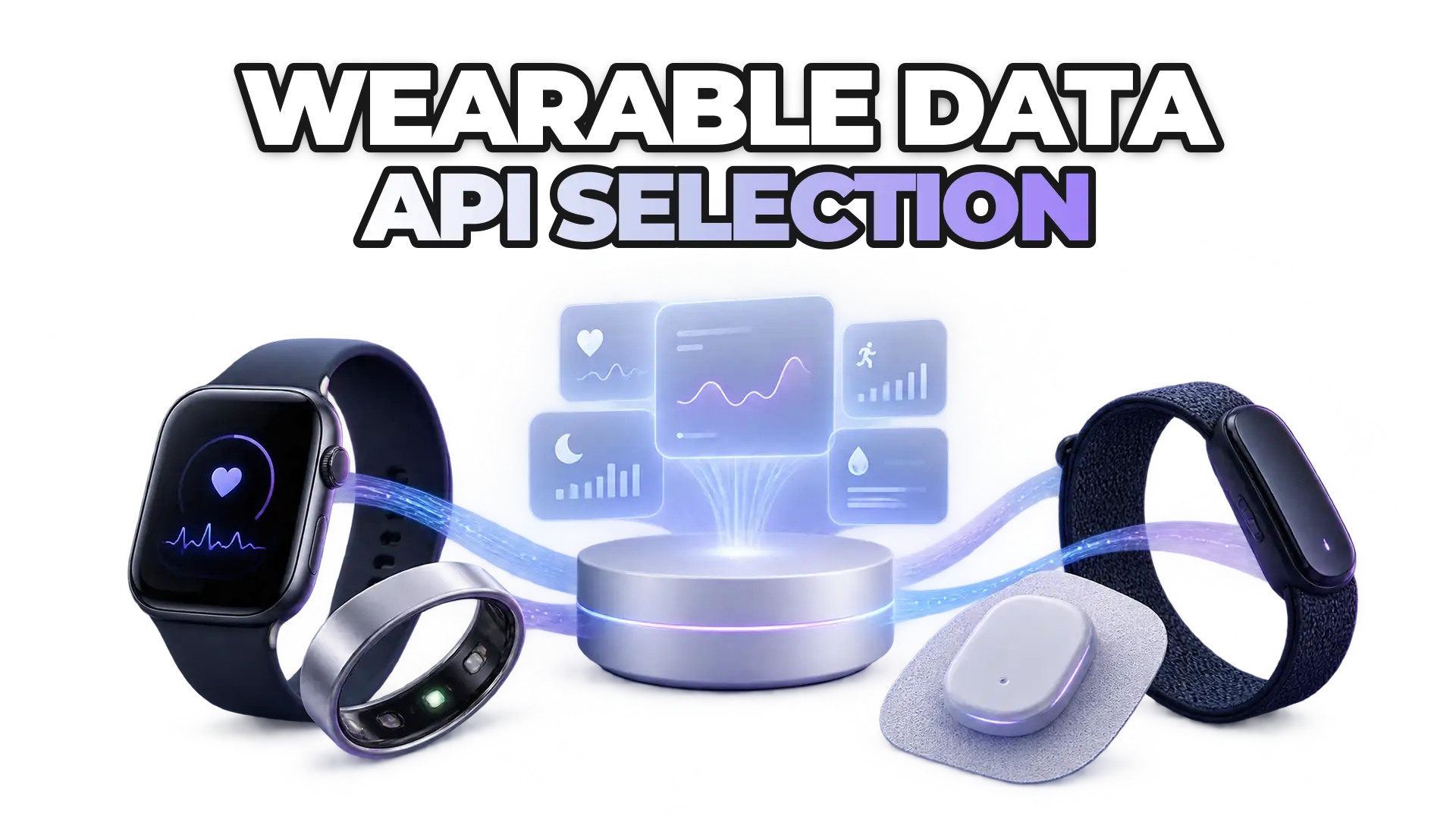
Selecting a wearable data API is a strategic decision. The architecture you choose will affect scalability, maintenance costs, analytics quality, and long-term product flexibility.
Many teams begin by integrating a single manufacturer. However, as device coverage expands, integration complexity increases.
In this article, we outline a structured framework to evaluate and choose a wearable data API in 2026.
Start with your product requirements
Before comparing providers, define your internal needs.
Key questions include:
Which industries or use cases are you supporting?
Do you need raw time-series data, structured summaries, or both?
Is cross-device comparability required?
What level of historical depth is necessary?
Do you require near real-time synchronization?
The first question is usually the fastest to answer by looking at what comparable teams built — our use cases and industries page groups them by sector. The rest are worth writing down before any demo call, and a provider's prerequisites for integration page will tell you quickly whether your answers are compatible with theirs.
Clear requirements prevent overengineering and reduce vendor lock-in risk.
1. Device coverage and ecosystem support
One of the first evaluation criteria is device coverage.
Consider:
Number of supported wearable brands
Types of devices (watches, rings, patches, bands)
Regional device popularity
Roadmap for adding new integrations
Check coverage at the level of the individual source rather than the headline number. A full list of supported data sources should let you open any one of them — Garmin, WHOOP, Samsung Health, Strava, Xiaomi or Zepp — and see exactly what that source provides and how it is authorized. Regional popularity is where headline counts mislead most: the brands that dominate one market barely register in another, a point discussed in Apple vs. Samsung vs. Oura – Who Wins in Health Tech?.
Supporting a broad ecosystem increases user accessibility. However, breadth without normalization may increase internal complexity — the theme of Mining Gold from 300+ Wearables: How ROOK Unifies Scattered Data.
Device coverage should align with your target audience, not just total integration count.
2. Metric depth and data granularity
Not all APIs provide the same level of detail.
Evaluate:
Available health metrics
Access to raw time-series data
Aggregated daily summaries
Sleep stage breakdowns
Activity intensity levels
Composite recovery scores
Ask for the catalogue, not a summary of it: a provider's data types reference and its data extraction documentation should tell you which metrics exist per source and at what resolution, and its add-ons page should make clear what is standard versus optional. If composite scores are part of your product, check whether they are the manufacturer's or the platform's own — for example ROOK Score 2.0 is computed from normalized inputs, so it behaves the same regardless of device.
Granularity matters when:
Building predictive models
Running longitudinal analysis
Supporting research-grade use cases
Request sample payloads to validate data structure and completeness.
3. Standardization and normalization
This is often the most overlooked criterion.
Ask:
Are metric definitions consistent across devices?
Are units normalized automatically?
Are time zones aligned?
Is there a unified data schema?
There is a simple test for this: ask the provider for its written definitions. If a definitions reference exists and each metric has one meaning across every source, normalization is a product. If it does not, normalization is your backlog. The processing stage where that happens should also be documented — see data processing — and the broader ambition behind it is what we discuss in How ROOK is Creating a Universal Language for Health Tech.
Without normalization, your team must build and maintain internal mapping logic.
Cross-device comparability is essential for:
Risk modeling
Engagement scoring
Incentive programs
Population-level analytics
Standardization reduces downstream engineering costs.
4. Authentication and OAuth management
Wearable integrations rely on OAuth 2.0 authorization flows.
Evaluate whether the API provider:
Manages OAuth flows across manufacturers
Handles token refresh automatically
Provides webhook support for authorization updates
Supports user reauthorization flows
Read the authorization documentation before the sales deck: a data authorization reference should show how a user is connected, how a token is refreshed, and what happens when authorization lapses. If your team would rather not build the authorization UI at all during evaluation, the ROOK Extraction App handles user binding and source authorization end to end, which makes it a fast way to test a provider with real users before writing integration code.
Centralized token management reduces operational risk and simplifies compliance workflows.
5. Scalability and infrastructure readiness
As your platform grows, API performance becomes critical.
Assess:
Rate limit handling
Retry mechanisms
Webhook availability
Asynchronous data ingestion
Time-series data optimization
SLA commitments
Delivery mechanics are where this becomes concrete: the data delivery documentation should describe how records reach your backend, whether by webhook or polling, and what happens to a delivery that fails on your side.
Wearable data is continuous and accumulative. Infrastructure must support increasing user volume and historical depth.
6. Maintenance and version management
Manufacturers update APIs frequently.
Ask potential providers:
How do you manage manufacturer API changes?
How quickly do you implement updates?
How are deprecated endpoints handled?
Is backward compatibility maintained?
This is not a theoretical risk. Samsung's own migration guide from the Samsung Health SDK for Android to the Samsung Health Data SDK states that the older SDK is deprecated and will remain operational for at least two years after deprecation — a ten-step migration that lands on whoever integrated directly. A serious provider publishes its own migration guides and changelogs for the same reason.
Two conventions are worth asking about by name: whether the provider follows semantic versioning so a breaking change is visible in the version number, and whether deprecated endpoints announce themselves through the Sunset HTTP header (RFC 8594) rather than failing silently one morning.
If integrating directly with manufacturers, your team must monitor and adapt to each change independently. A unified API provider should absorb this complexity — the shift described in From Wearables to APIs.
7. Privacy, security, and compliance posture
Wearable data often contains sensitive information.
Evaluate:
Encryption standards
Data storage practices
Access controls
Compliance documentation
Regional data handling policies
Ask for:
Security documentation
Data processing agreements
Audit certifications, if available
When you ask about certifications, ask which standard and which scope: ISO/IEC 27001:2022 is the information security management standard most providers will cite, and the statement of applicability behind it is what tells you whether the certificate actually covers the service you are buying.
Security posture should align with your regulatory exposure.
8. Data ownership and portability
Clarify contractual terms related to:
Data ownership
Export capabilities
Migration processes
Vendor lock-in conditions
A well-structured API relationship should not restrict your ability to access or migrate your data. A practical proxy for this is how configurable the account is on your side without a support ticket — see portal configuration.
9. Developer experience and documentation
Strong documentation reduces integration time.
Evaluate:
API reference clarity
Example requests and responses
SDK availability
Sandbox environments
Error handling documentation
Judge this by opening the docs, not by asking about them. A provider should have a browsable API reference, a quickstart that gets you to a first response quickly, and SDKs for the platforms you actually ship on rather than a single example in one language.
One more thing to check: whether the API reference is generated from a machine-readable contract. The OpenAPI Specification, whose version 3.2.1 was published in September 2026, is what makes that possible — and a provider that publishes one gives your team client generation, mocking, and contract testing for free.
Developer experience directly affects time to market.
10. Total cost of ownership
Cost evaluation should go beyond pricing tiers.
Consider:
Integration time
Ongoing maintenance
Internal normalization effort
Infrastructure costs
Compliance overhead
Engineering bandwidth
Compare the published plans of each candidate against the engineering months you would otherwise spend, not against each other in isolation. A lower upfront cost may result in higher long-term operational expense.
Total cost of ownership provides a more realistic comparison.
Direct integration vs. unified wearable API
There are two primary approaches.
Direct manufacturer integration
Pros:
Full control over each connection
Direct access to manufacturer data
Cons:
Higher engineering overhead
Fragmented schemas
Ongoing maintenance per integration
Slower expansion to new devices
Unified wearable data API
Pros:
Single integration
Normalized data model
Reduced maintenance
Faster scalability
Cons:
Dependency on third-party provider
Need to evaluate vendor reliability
For most multi-device strategies, a unified API reduces long-term complexity. What that architecture looks like from the inside — authorization, extraction, processing, and delivery as distinct stages — is set out in the ROOKConnect documentation.
Evaluation checklist
Before making a decision, confirm:
Device coverage aligns with your audience.
Metrics meet your product requirements.
Data is standardized across manufacturers.
OAuth management is centralized.
Infrastructure supports scale.
Security posture matches compliance needs.
Documentation supports efficient development.
Total cost of ownership is sustainable.
Structured evaluation reduces architectural regret later. It also means asking harder questions than a feature grid invites, which is the spirit of Demand Better from WEARABLES.
How we approach wearable API infrastructure at ROOK
At ROOK, we provide a unified API designed to reduce integration complexity.
Our approach includes:
Single integration across hundreds of wearables
Standardized metric definitions
Centralized OAuth management
Structured, analytics-ready data
Ongoing manufacturer API maintenance
We focus on delivering usable data so teams can concentrate on building product features rather than maintaining integrations — the thinking behind the platform, which we unpack in Data-driven Health: Building the API Powering the Future of Preventive Medicine.
The wider podcast and media hub collects these conversations, earlier interviews cover how the platform was built and what it took to unify scattered sources, and our partner and alliance episodes feature companies describing the evaluation they ran before choosing an infrastructure provider.
Final thoughts
Choosing a wearable data API is not only a technical decision. It is a long-term architectural commitment.
The right solution should:
Support scale
Reduce maintenance burden
Ensure data consistency
Align with privacy requirements
Enable product flexibility
In 2026, organizations that prioritize structured, normalized, and scalable wearable data infrastructure will be better positioned to build durable data-driven products.
 Written byJuana Carolina Ordoñez MerchanInternal Digital Marketing