Blog
How wearable APIs work: from device to actionable insights
Integrating wearable data into your product requires more than connecting to a single endpoint. Behind every metric there is an ecosystem that includes devices, manufacturer platforms, authorization flows, and data…
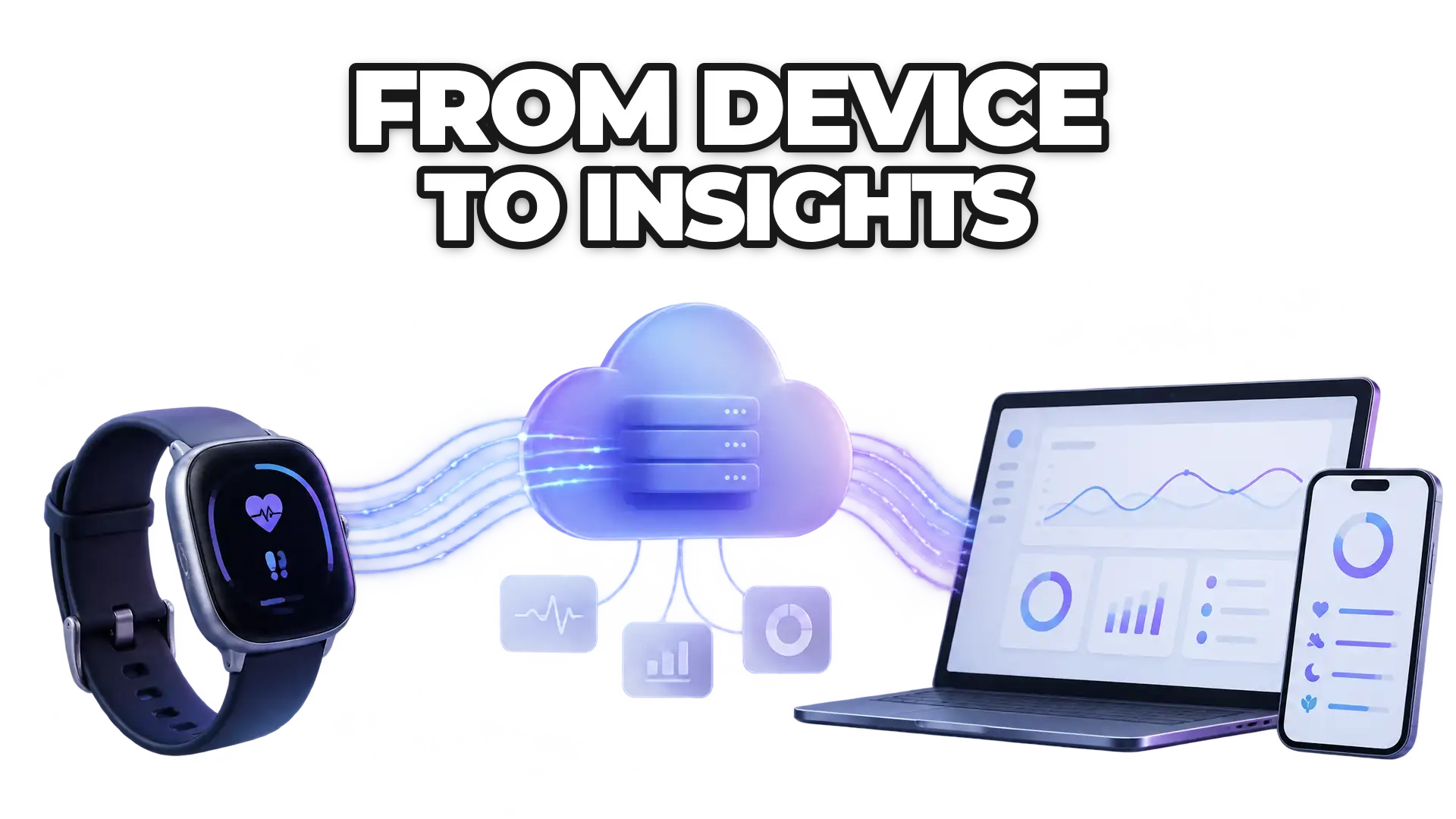
Integrating wearable data into your product requires more than connecting to a single endpoint. Behind every metric there is an ecosystem that includes devices, manufacturer platforms, authorization flows, and data transformation processes.
In this article, we explain how wearable APIs work, the typical data flow from device to application, and what to consider when designing a scalable integration architecture. If you are exploring the process for the first time, our guide to how to access health data from wearables provides additional context.
The wearable data ecosystem
Before discussing APIs, it is important to understand the ecosystem involved in wearable data integration.
The typical actors include:
The wearable device
The manufacturer’s cloud platform
The manufacturer API
The end user
Your application
An aggregation or normalization layer, if used
Each layer introduces technical and operational considerations. Reviewing the wearable and health data sources supported by ROOK helps clarify which connections use cloud APIs and which require mobile SDKs. For teams deciding whether to integrate multiple APIs directly or through a unified layer, see the problem with direct integrations and why a platform needs a unified API.
Step one: data collection on the device
Wearable devices collect raw biometric signals through embedded sensors, such as:
Optical heart rate sensors
Accelerometers
Gyroscopes
Temperature sensors
Pulse oximeters
The device processes part of this information locally and periodically syncs it with the manufacturer’s mobile app or cloud infrastructure.
Important considerations:
Sampling frequency varies by device.
Some data is processed on-device, other data in the cloud.
Firmware updates may modify metric calculations.
For mobile health ecosystems, Apple HealthKit provides a framework through which applications access and share health information with user permission. This is a different access path from a manufacturer’s cloud API.
Step two: data storage in the manufacturer cloud
Once synchronized, data is stored in the manufacturer’s cloud platform.
At this stage:
Raw signals may be transformed into higher-level metrics.
Daily summaries are generated.
Proprietary algorithms calculate composite scores such as recovery or readiness.
Your application does not communicate directly with the device. Instead, it interacts with the manufacturer’s cloud through an API.
This describes the cloud-based integration path. The Garmin Connect Developer Program provides a concrete example: users synchronize their devices with Garmin Connect, after which uploaded information becomes accessible through the API.
Step three: user authorization (OAuth)
Before accessing wearable data, the user must grant permission.
Most manufacturers use OAuth 2.0 for authorization. The process typically includes:
Redirecting the user to the manufacturer’s authorization page.
The user logging in and granting access.
The manufacturer returning an authorization code.
Exchanging the code for an access token.
Key considerations:
Access tokens expire and require refresh logic.
Scopes define which data your application can access.
Consent management must align with privacy regulations.
Proper token management is essential for maintaining uninterrupted data access.
The IETF OAuth 2.0 authorization framework defines the underlying authorization-code process and the roles of access tokens, scopes, and refresh tokens. Provider-specific implementations determine the exact requirements for each integration.
Step four: requesting data through the API
Once authorized, your application can request data from the manufacturer’s API.
Common characteristics of wearable APIs:
REST-based architecture
JSON responses
Time-range query parameters
Rate limits
Pagination
Example types of endpoints:
Daily activity summaries
Sleep sessions
Heart rate time series
User profile data
Challenges at this stage include:
Different endpoint structures per manufacturer
Different time formats
Inconsistent metric names
Variable historical depth
If you integrate multiple manufacturers directly, your backend must handle each structure independently. Our guide to integrating data from multiple wearables into one system explores how these differences affect the integration workflow.
Step five: data transformation and normalization
Data retrieved from wearable APIs is rarely ready for direct product use.
Typical transformation steps include:
Mapping fields into a unified schema
Converting units of measurement
Aligning time zones
Standardizing metric definitions
Handling missing or duplicated records
Without normalization, cross-device analytics becomes unreliable.
For example:
One API may return sleep duration in seconds.
Another may return minutes.
A third may segment sleep differently.
A unified data model reduces downstream complexity. Our guide to standardizing health data from different devices explains this process in more detail, while our article on eliminating duplicate wearable data records addresses another important part of data integrity.
Real-time vs. batch synchronization
Wearable APIs typically support one of two synchronization models.
Batch-based synchronization
Data is requested periodically.
Suitable for daily summaries.
Simpler to manage.
Webhooks or near real-time updates
The manufacturer notifies your system when new data is available.
Reduces polling.
Improves responsiveness.
Not all manufacturers support webhooks, which creates architectural inconsistencies when integrating multiple APIs.
A notification also does not guarantee that data arrives immediately after measurement: device synchronization and source processing still affect availability. The ROOKConnect documentation explains how extraction, processing, and delivery fit into the broader data lifecycle.
Common integration challenges
When working directly with wearable APIs, teams often encounter:
API version changes
Deprecated endpoints
Rate limits
Data gaps
Inconsistent historical availability
Differences in composite metric calculations
As the number of integrations increases, so does operational complexity.
These challenges are explored further in our article on the problem with direct integrations, including the maintenance and scalability implications of managing providers separately.
Direct integration vs. unified wearable API
There are two main architectural approaches.
Direct integration
You integrate each manufacturer separately.
Advantages:
Full control over each connection
Direct access to manufacturer responses
Limitations:
Higher engineering overhead
Ongoing maintenance per integration
Fragmented data models
For teams evaluating this approach, our analysis of whether to build wearable integrations in-house or use an API provides additional context for the decision.
Unified wearable API
You integrate once with an aggregation layer that connects to multiple manufacturers.
Advantages:
Single integration point
Normalized data model
Reduced maintenance
Faster time to market
This model simplifies backend logic and improves scalability. Our article on why a health platform needs a unified API explores how shared integration infrastructure supports connected product experiences.
Designing a scalable wearable API architecture
When building a wearable data integration layer, consider:
Token lifecycle management
Retry logic and error handling
Monitoring and logging
Data validation rules
Schema versioning
Storage strategy for longitudinal analysis
A scalable architecture must support:
Growing user bases
Increasing data volumes
New device integrations
Regulatory requirements
Planning for these factors early reduces future rework.
The impact extends beyond infrastructure. These capabilities support the workflows described in ROOK’s use cases across healthcare, fitness, wellness, insurance, and pharma.
How we approach wearable API integration at ROOK
At ROOK, we provide a unified API that connects applications to data from hundreds of wearables through a single integration.
Our approach includes:
Managing OAuth flows across manufacturers
Normalizing data structures
Maintaining consistent metric definitions
Handling API updates and changes
Delivering structured data ready for product and analytics use
By centralizing integration, we reduce the operational burden on product and engineering teams.
For teams that need a prebuilt mobile collection experience, the ROOK Extraction App documentation explains how to connect supported sources without first developing a custom mobile application. For applications that use health assessments, the ROOK Score 2.0 documentation describes its physical, sleep, and body health inputs and outputs.
We also explore these integration decisions through our podcast and media hub. The conversation on data integration and its utility in the industry provides additional perspective on turning connected wearable data into useful information.
Final thoughts
Understanding how wearable APIs work is essential before building features that depend on wearable data.
The complexity does not lie in making a single API request. It lies in managing multiple manufacturers, maintaining consistency, and ensuring long-term scalability.
A well-designed integration strategy allows teams to focus on generating insights rather than maintaining fragmented connections. That is the foundation of ROOK’s approach to making health data actionable: connecting data access with the structure and context needed to support useful product decisions.
 Written byJuana Carolina Ordoñez MerchanInternal Digital Marketing